

“The economic issue has never been whether one is a liberal or conservative, Democrat or Republican, or other such misleading taxonomic delineation. The issue revolves exclusively around one’s perception of human behavior.”
– Arthur B. Laffer, Ph.D. (Los Angeles Times, 1981)
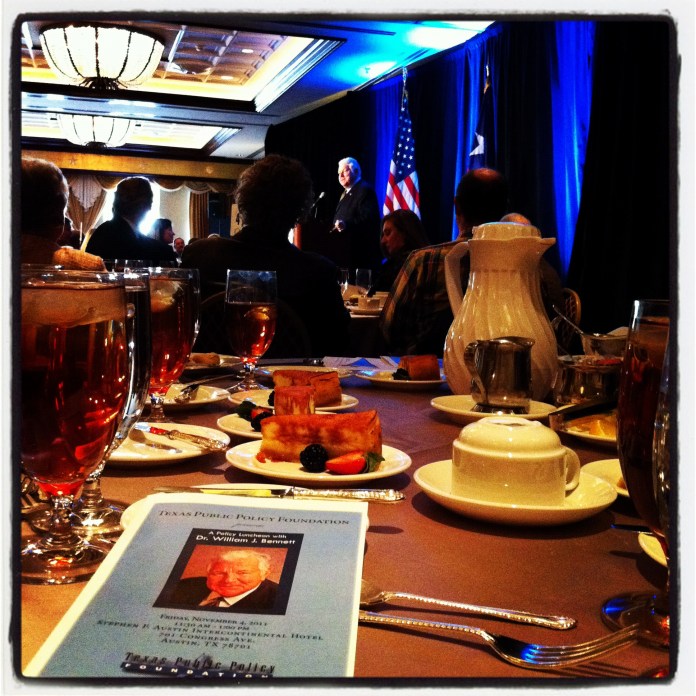
I became interested in Arthur Laffer and his work during a luncheon held in spring, 2011 in Austin by the Texas Public Policy Foundation. During the event, the establishment of The Laffer Center for Supply-Side Economics was announced.
Why should nonprofit organizations care about the economy?
I have friends of all political persuasions, and I hold two degrees from The University of Texas at Austin, one in cultural studies and the other in art history. I have no formal training in economics. But I do have 30 years of experience working in trenches of the nonprofit sector raising significant funds. And, I am constantly in touch with donors of all political persuasions, many of them significant philanthropists and investors. Most would agree a strong economy sets the stage for significant charitable gift fundraising activities.
As well-meaning and sincere as nonprofit organizations can be, generally speaking I have not known them to pay attention to the one thing that could make their work of securing financial support easier, the one thing that ultimately enables them to attain their many worth missions: a healthy, thriving economy (made up of healthy, thriving corporations and capitalists).
A colleague affiliated with CharityChannel Press mentioned to me in the midst of the recent economic crisis, “we all know what’s wrong with fundraising today, it is the economy.” I couldn’t agree more.
The Laffer Center notes:
… “In the roughly 30 years from the 1980s through the first decade of the new century, supply-side ideas contributed to the longest boom in United States history and an incredible transformation of the world economy. According to the National Bureau of Economic Research, 1982-1999 was one continuous mega-economic expansion. In fact, as it stretched into 2007, this 25 Year Boom saw a tripling in the net wealth of U.S. households and businesses from $20 trillion in 1981 to $60 trillion by 2007. When adjusted for inflation, more wealth was created in this 25 year boom than in the previous 200 years.”
The “trickle down” theory promoted by President Reagan is noteworthy. But as 2020 drew to a close, research from the London School of Economics suggested, “Fifty Years of Tax Cuts for Rich Didn’t Trickle Down” (December 15, 2020). Their findings, “counter arguments, often made in the U.S., that policies which appear to disproportionately aid richer individuals eventually feed through to the rest of the economy.” The timespan of the paper ends in 2015, so we will have to wait and see once the research is updated to include the intervening years.
Regardless of your view about the best economic system, nonprofits must pay attention, both from an historical and contemporary context, and act appropriately. The nonprofit sector should educate itself about what drives a healthy economy and enables it to flourish, and we should do our respective parts to support those activities, rather than to discourage them.
Few are aware that nonprofit organizations as a group have a strong impact on our nation’s economy. The National Council on Nonprofits notes,
“In addition to the economic activity encouraged by nonprofits and the countless dollars that nonprofits save governments through their efficient service delivery, nonprofits are also one of the greatest sources of employment across the country. According to the Bureau of Labor Statistics, the nonprofit sector employs 11.4 million people – that’s 10.2 percent of the American workforce!”
In my opinion, nonprofits should be working harder to point out these kinds of facts and be constantly emphasizing their importance so that society as a whole gains a better understanding and appreciation of the role nonprofit organizations play in our world today.
The economic lessons of the past are clear. Whatever your political opinion, take the time to understand how the nation’s economy works and be part of the solution, not part of the problem.
Additional Discussion: Capitalism Pros and Cons
- Business Initiative, “Philanthropic Landscape 2025” (September 2025).
- Trickle down or … trickle up? Michael Evans writes for Forbes, “Job Creation In The New Political Economy: Small Companies, Not Big Companies, Create Jobs” (February 8, 2017).
- Fortune continues to provide outstanding leadership in the corporate arena. You might enjoy reading their section on philanthropy.
- Harvard Kennedy School, “Wanted: New economic models for a post-globalization world” (February 16, 2022). We need a national panel discussion on the findings from the research conducted.
- Mark Karlin for Truthout, “The Limits of Trickle-Down Philanthropy” (January 10, 2016).
- Jeff King, CEO of Barkley, wrote an excellent review of the book for Forbes that you might, “Only Conscious Capitalists Will Survive” (December 4, 2013).
- National Council on Nonprofits, “Economic Impact.” If I were to give advice to potential donors interested in long term health of the nonprofit sector overall, it would be to fund continuously updated statistical information about the impact of nonprofits on our nation’s economy.
- Douglas Rushkoff was interviewed by Nonprofit Quarterly, “The Sustainability Prerogative: Nonprofits in the Future of Our Economy” (April 25, 2017). “I think that the nonprofit sector in particular is perfectly situated to help us transition to a different economic landscape. You know, most nonprofits think of themselves as doing something good, but what I want to try to make them more aware of is that the nonprofit structure itself, the way the business is actually structured, may be doing more good than whatever their particular business is.”
- RSM, “Nonprofit industry outlook” discusses the impact of the economy on nonprofits and trends (July 23, 2025).
- Devin D. Thorpe of Forbes featuring John Taft, “Wall Street Can Be a Force for Good” (March 31, 2015).
You might also enjoy reading my article and a post:
 Carolyn's Nonprofit Blog
Leave a comment