“Without libraries what have we? We have no past and no future.”
Ray Bradbury, American Writer (1920-2012)
Before tossing out old papers, photographs and books, be sure to consult a library.
I find it is often the case that you think your family documents have no value. But if you have even a glimmer that they might have some historical merit, reach out to a librarian. Be sure you are not throwing out nor giving away items valuable to history and to future generations.
From antique cookbooks to nonprofit activities, from photographs to research documents, check to see if your holdings might be of interest to your local library or to a national archive. I have heard tragic tales about people thinking the papers of their ancestors are worth nothing, they toss them out, and low and behold, an enterprising trash collector makes a stunning find and sells the item(s) for a substantial amount. The National Archives notes, “maybe a relative sent you old letters, certificates, and family photographs and you are not sure what to do. Maybe you’re wondering how to save your child’s pictures and other mementos.” If you need information about preserving historic family documents, follow this link to helpful professional advice regarding papers and photographs.
The past decade, I have been going through my own family documents. The process is time consuming but a worthwhile endeavor, and I urge you to do the same.

As a tribute some of my favorite libraries, I am sharing my own contributions. Please support them financially and with your own historical documents and book donations.
Austin History Center, a division of the Austin Public Library. I was a friend of the late Frank W. McBee, Jr., whom I met while working at my first “development” job in the mid-1980s. Frank founded Austin’s first Fortune 500 company, Tracor. His wife, Sue Brandt McBee was one of the founders of the Austin History Center and they both worked to preserve the rich architectural history of Austin, with “home base” being the Bremond Historic Block. Hence, I think of the Center fondly. My gifts include the following.
I donated my documents from the creation of the first Texas Nature Conservancy and Greater Austin Chamber of Commerce corporate conservation leadership event in Austin in 1993. This event changed the perception of the “environmental” movement in Texas in dramatic ways, placing it on a stronger footing with many of our state’s leading corporations, foundations and philanthropists. You can read details about the event on Carolyn’s Nonprofit Blog, “A Special Event | An Environmental Breakthrough for Texas.”
In 2021 and again in 2026, I donated documents related to my work in the nonprofit sector in the 1980s and early 1990s in Austin. This was when I began my career in nonprofit fundraising. Professional and volunteer project documents for a variety of organizations were included, and it is my hope an historical project focusing on Austin’s early nonprofit history will be developed in the years ahead.
In 2022, a set of beautiful black and white photographic negatives and contact sheets – along with a few prints – by celebrated Austin photographer Ave Bonar were donated to the Austin History Center. They date to 1984 and are of my wedding reception at Caswell House, a historic event venue in Austin. Included are images of the late Mel and Zeta Sikes, longtime friends (I also worked for Mel while a work-study student during graduate school), as well as other Austinites, many affiliated with UT Austin and Laguna Gloria Art Museum. While the marriage did not last, Ave’s photographs certainly did.
Briscoe Center for American History at The University of Texas at Austin. Some of my college memorabilia dating from the 1970s and 1980s is found here (Punk Rock ephemera to a polished graduate research paper on the Texas artist Frank Reaugh, whose archive is found at the Center), and Civil War era documentation from my mother’s side of the family. See Carolyn’s Tumblr for a write-up about an eye-opening personal account of the Battle of Gettysburg and Pickett’s Charge by one of my mother’s ancestors, one of the few survivors.
Mary and Jeff Bell Library at Texas A&M University Corpus Christi. My Legorreta + Legorreta museum wing fundraising documents for the Art Museum of South Texas during the mid-2000s, including videotapes of the late Ricardo Legorreta speaking at the start of our revival of the multi-million-dollar capital campaign. I took the languishing initiative over, doing all work myself from campaign design to implementation, and through my own prior contacts, brought in $1 million in donations as part of a total of $5 million raised over the course of three years. From Carolyn’s Nonprofit Blog, you can read about some of my work on the then-new Legorreta wing. The library also houses documents from the creation of the earlier Philip Johnson designed museum dating to the 1970s.
California State Library. In 2024, I donated several items of punk rock-era ephemera from various of my sisters’ prior bands, which are now in the California History Room. In brief, after securing a double degree in Opera and Flute from UCLA in the 1980s, my sister pursued a rock career, and she has continued to write music and perform in her home state of California. When moving to a new home in 2024, I went through every single personal file and discovered I had saved several items in perfect condition ca. the 1980s. I obtained her approval to donate them to the California State Library.
Lake Travis Community Library. Numerous quality hard cover books were donated during 2019, 2020 and 2021, several autographed by the authors, probably close to 75 books. While some items help build their already substantial book collections, some that were less rare but in excellent condition can be sold at their little bookshop, which is located at the main library. I am happy for that to be the case.
New Mexico Farm and Ranch Heritage Museum. While not a written document, I wanted to mention that my grandfather’s 32 Special Winchester rifle has been donated to the museum in Las Cruces, New Mexico (2021). My thanks go to Sportsman’s Finest in Bee Cave, Texas for helping me convey the rifle safely and legally from Texas to New Mexico.
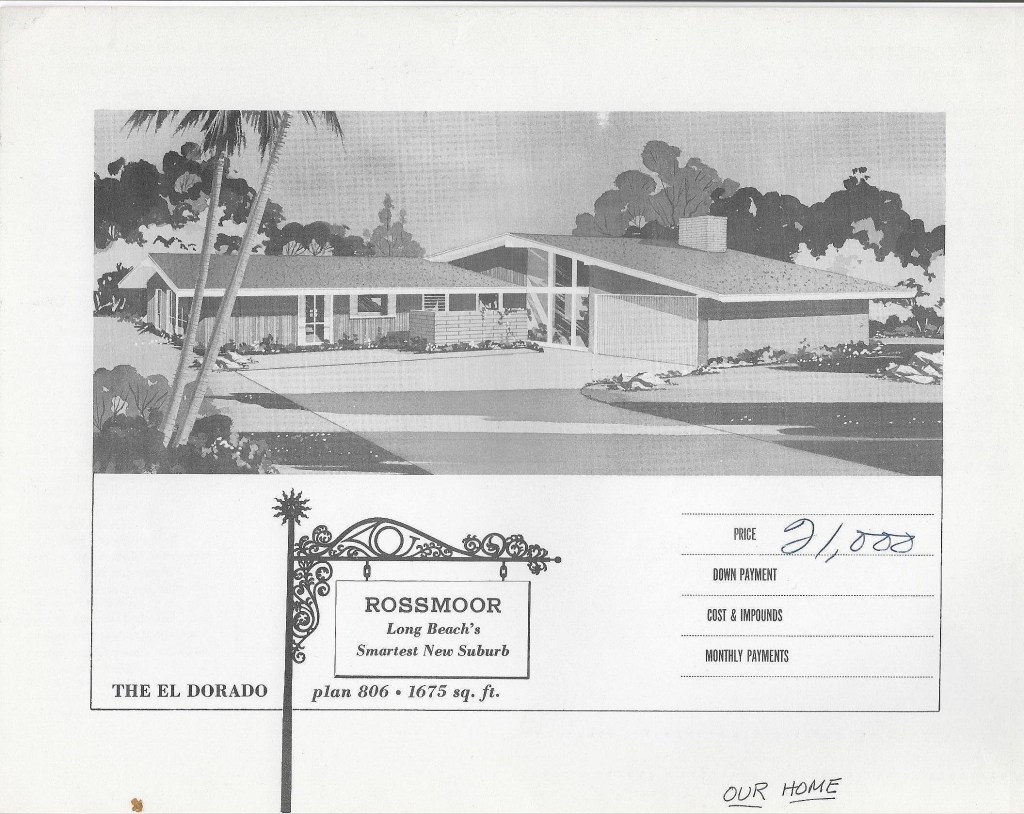
Orange County Archives. I was delighted to send to the Orange County Archives one of the original Rossmoor home development brochures dating to 1960. Our father purchased a home plan for the new development, and we watched it being built. Included in the donation were some photos by my father of construction, and one of me with a close friend, Leslie Fink, who lived down the block. We were inseparable.
Panhandle-Plains Historical Museum. I am related to one of Amarillo’s leading families of the early 20th century, Mary Honeyman Ten Eyck and railroad executive Avery Turner. Avery and his brother-in-law R. Clarence Ten Eyck (of Santa Fe, New Mexico), helped bring the railroad to several then-new locations in the Southwestern United States. Initially, I donated a 19th century cabinet photograph of Avery Turner handed down to me by my father, and an antique postcard of Aunt Mary driving her Pierce-Arrow. She was the first woman in Amarillo to secure a driver’s license. Also donated are an elaborately illustrated book about Egypt inscribed by Aunt Mary to my grandmother and namesake in Santa Fe, New Mexico, artist Mary Carolyn Ten Eyck Appleton (Mary’s niece); copies of Mary’s books and photographs of the historic Turner home in Amarillo; and letters between my grand uncle, MIT graduate and inventor Harold Ten Eyck, who served aboard the USS Essex during WWII, and Mary Honeyman Ten Eyck Turner. Harold’s birth parents were Clarence and Nettie Ten Eyck of Santa Fe; his second set of parents were his aunt and uncle, the Turners of Amarillo, smiles. If you are on Ancestry.com, our family tree is the “Appleton, Ten Eyck and Booker” family tree. I am the sole creator and manager, and it continues to grow, even today as more information is uncovered.
Mary Honeyman Ten Eyck Turner was throughout her life a leader in the National Society, Daughters of the American Revolution. She created a chapter called the Llano Estacado Chapter in Amarillo, which eventually became the Molly Goodnight Chapter. The Chapter celebrated its 100th anniversary in 2025, and I was pleased to speak during the celebration about Aunt Mary, as our family called her. Mary was active locally, across Texas, and nationally. During the 1930s she chaired the “conservation committee,” and helped launch the Penny Pines project with the U.S. Forest Service. The Turner home on Polk Street does have a historic marker from the Texas Historical Commission.

Perry-Castaneda Library, The University of Texas at Austin. I donated a hard copy, illustrated, color Arabic-to-English dictionary given to me while I was taking Arabic at UT Austin by a member of a influential family who was living in my co-ed dorm back in the mid-1970s. I eventually secured a B.A. in Middle Eastern Studies With Honors, and I received high marks for tackling the Arabic language (I was one of the early participants in the Abboud computer learning system).
Texas Grant Resource Center, The University of Texas at Austin. I donated several books about fundraising and communications – several autographed by the authors. The hope is that aspiring fundraisers will find them helpful.
Texas State Library and Archives. I documented eight years of volunteer service for the Texas Commission on Environmental Quality under former Texas Governor Rick Perry, in my capacity as a Governor-appointed and reappointed member of the Texas Environmental Partnership Fund Board. My archives document the commission’s research for the State of Texas on how to ensure science-based K-12 environmental education for all Texans, and ultimately enabled the Texas Legislature to understand what we accomplished and to bring our commission’s work to a formal conclusion. I was chosen for this assignment by the late Richard C. Bartlett, Vice Chairman of Mary Kay Corporation, with whom I worked closely at the Nature Conservancy in the 1990s. After working with that nonprofit and other conservation organizations, and having a big picture view of their challenges and successes, I was able to lend my experiences and perspectives, and to share some realistic solutions.

University of New Mexico, Zimmerman Library, Southwest Collections. I have continued to add to my late father’s existing family archive, which I encouraged him to establish a few decades ago. The late David Ten Eyck Appleton was born and raised in Santa Fe, New Mexico, and his grandfather (my great grandfather) R. Clarence Ten Eyck helped bring the railroad to New Mexico and nearby states, along with a booming tourist industry. The Appleton Family was also active in bringing a more sophisticated cultural life to Santa Fe. Artistic work including early photographs of American Indians, film and audio recordings, and scientific research by Norman Roy Appleton, which was funded by the WPA and focused on a natural method of eradicating tent caterpillar infestations in the aspen groves of the Aspen Basin above Santa Fe, are included.

In 2024, extensive correspondence and items dating to the 19th century from the Ten Eyck side of the family were contributed to the Appleton Family Papers. Railroad historians will find these documents of interest. I hope scholars will research and write about the early history of the railroad’s expansion in New Mexico, Colorado and the Panhandle of Texas. This stretch of railroad would eventually become BNSF Railway.
In 2025, letters from Harold to his birth parents Clarence and Nettie Ten Eyck of Santa Fe were donated to the Zimmerman Library.
Note: Items in this archive and those in the Panhandle-Plains Historical Museum in Texas should be considered closely intertwined. Scholars will want to investigate both for a complete picture of the railroad expansion across the Southwest.
University of Texas San Antonio Libraries Special Collections. My family’s cookbooks dating from the second half of the 19th century through the 1960s, my personal 1960s vintage Camp Fire USA guidebook, and a 19th century guide to homesteading that I acquired at an estate sale in Austin in the early 1980s have been donated. In conducting research on antique cookbooks, I notice not many libraries focus on cookbooks, but they are fascinating and insightful aspects of the material culture of prior generations.
Rob & Bessie Welder Wildlife Foundation conservation library. The library contains approximately 24,000 individual books and journals. In the rare books collection are numerous highly valuable volumes, some dating to the 1600’s. As an example, the collection contains a complete set of the journal Audubon. My personal opinion is that a new, larger and more secure library facility needs to be funded at the Welder Refuge. And all the student research held in those collections should be digitized for ease of access. Several of the books I have donated over the years are autographed by the scientists who wrote them, and they total almost 100, dating from my time working in the environmental movement.
White Pine County Library, White Pine County, State of Nevada. My mother was born and raised in northern Nevada and she shared many fond memories with my sister and me over the years, but also some challenging aspects of life in and around that significant copper mining operation. My grandfather was Karl W. Booker, Chief Engineer, Mining Department, Nevada Mines Division, Kennecott Copper Corporation in Ruth, Nevada. I donated some of his few remaining artifacts, and family photos of life in that region of Nevada, in 2021. The mine is now part of Rio Tinto, and I have reached out to them about helping the community create a professional history museum. This beautiful area of Nevada is becoming a popular tourist destination.
Our late father’s Apollo Program documents are in the Huntington Library in Southern California, as part of The Planetary Society’s holdings. You can read more about those on Carolyn’s Nonprofit Blog. Our father also spearheaded a project to send men to Mars, but the program was not approved by Congress back in the 1970s. Luckily, SpaceX and other pioneering private sector programs are pursuing his dream today. To read my father’s own words about his work and archive donations, follow this link to ISSUU.
Additional resources for librarians:
Margo Note, “Creating Family Archives: A Step-by-Step Guide to Saving Your Memories for Future Generations” (2019)
 Carolyn's Nonprofit Blog
Leave a comment