In this post, I wanted to point out insightful research and reports I find timely regarding philanthropy in our world today. While news in the media can be tumultuous and confusing, nonprofits need to focus and keep moving forward in methodical ways. And, while you know your own community well and the constituents who are your best donors and volunteers, there are fascinating insights to be learned about the “big picture” of philanthropy today.
In the article, “the 2025 philanthropy landscape,” Altrata shares good news amidst the apparent chaos.
The global economy is changing rapidly amid shifting trade policies, geopolitical conflicts, funding cuts, and more. As long-standing economic dynamics are undermined or dismantled, the impact is casting a long shadow of uncertainty in the forecast. Understandably, many in the nonprofit sector now worry about the future of charitable giving.
Fortunately, the numbers show a much brighter outlook than news headlines. According to Altrata’s data, the philanthropic engine not only continues to run, but in many ways, it’s picking up speed. Despite the challenges, well-informed fundraisers can expect charitable contributions from the world’s most affluent individuals to reach new heights. Here’s what you need to know about the state of giving in 2025.
I live in Central Texas, a community many would consider young and vibrant. When visiting with my colleagues, I often find they are tired of “Boomers” and want new and exciting projects focused on younger generations. That’s a great idea.

But if you are seeking meaningful and larger gifts for your worthy nonprofit mission today, Baby Boomers and the Silent Generation still reign supreme. Of course, this will not last forever as these older groups age out, as they say.
Look at where younger generations place philanthropy in their interests! Our sector needs to do some work to make philanthropy a higher-level focus for up-and-coming generations.
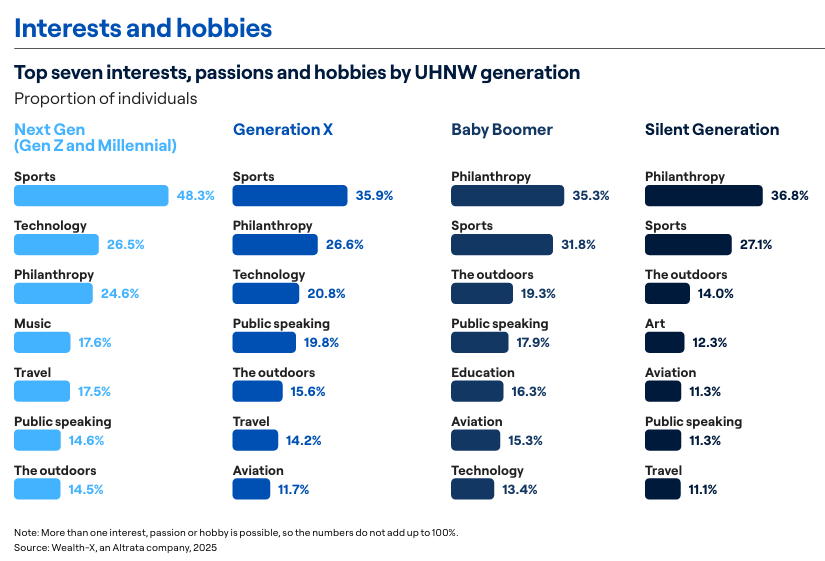
Check out Altrata’s report, “World Ultra Wealth Report 2025.” It notes that $207 billion of charitable donations, 36% of all giving by individuals, is attributed to the ultra-wealthy. And most people in this category live in the United States.
Jack Nicholaisen shares for Business Initiative a few takeaways about philanthropy today that should inspire you.
- Record giving creates opportunity: $592.5B in 2024 charitable giving shows unprecedented resources available, with individuals contributing 66% of total donations.
- The Great Wealth Transfer is here: $124T shifting to Millennials and Gen Z over 25 years requires new engagement strategies focused on impact and digital connection.
- AI adoption is accelerating: 77% of nonprofits plan AI implementation within 3-5 years for personalized communications and predictive donor analytics.
- Corporate partnerships are growing: $44.4B in corporate giving (+9.1%) presents massive opportunities, with billions in matching gifts still unclaimed.
- High-net-worth focus on impact: Top donors expect transparency, measurable outcomes, and personalized engagement—lessons all nonprofits can apply.
Bank of America’s “Navigating change with purpose” observes, “Personal values remain the strongest motivator for charitable giving among affluent Americans. When deciding which causes to support, 68% of affluent donors are guided by their personal values or beliefs, while 57% are motivated by their interest in specific issue areas. This deeply personal connection to giving helps explain why 87% of donors report finding their charitable giving personally fulfilling.” And volunteering continues to rebound, not decline.
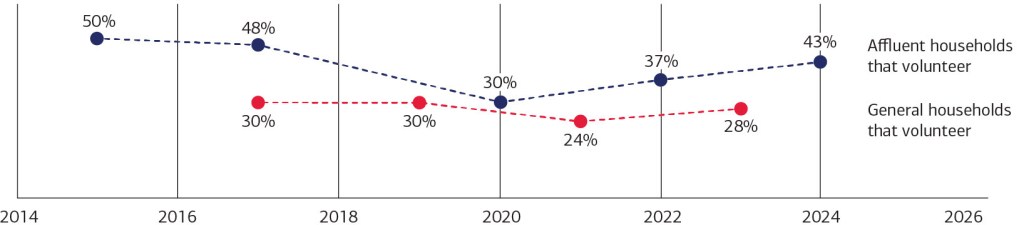
You might also enjoy downloading the 2025 Bank of America Study of Philanthropy from the website of the Lilly Family School of Philanthropy.
So, how do we get our nonprofit causes before donors, regardless of their age and wealth? This is a challenge, with online traffic and competition being more intense than ever. But there are some simple, basic steps you can take.
I am a big fan of Candid and GuideStar. Each nonprofit with which I work is urged to claim and complete their free profile, earning at least the Gold Seal. Here is a helpful overview from Candid.
If your nonprofit hasn’t claimed or updated its GuideStar profile, you could be missing out on funding, credibility, and donor trust.
And it isn’t just donors who are checking out your profile on GuideStar, professional advisors from trust officers to investors and accountants are, too. And often, they will consult your GuideStar profile and your website before they visit with you in-person.
Testimonials continue to rank high, as most people trust those who know. Check out The Modern Nonprofit, “From Stories to Support: The Nonprofit’s Guide to Acquiring and Using Testimonials.”
Getting Attention shares very helpful advice in, “501(c)(3) Website Requirements: What to Include on Your Website.” In a webinar hosted by a donor advised fund that I enjoyed earlier this year, one key component requested by DAFs is simply placing your EIN on your nonprofit’s website, thereby making it easy for donors and partners to find.
Is social media important for nonprofits? I think at long last our sector has finally understood that it truly is. Rob Pugh writes for Jetpack, “Social Media for Nonprofits: Benefits, Strategy, and Best Practices.” He notes, “It’s not all about finding new supporters – social media can be used to bolster relationships with existing donors and volunteers as well. Nonprofits can thank their donors for their contributions and share updates and individual stories about the impact their donations have had in the real world.” I am a fan of the occasional Facebook, website post, and Google Ad “boost.” A little online “push” can do a lot.
If you review Carolyn’s Nonprofit Blog, you will find more helpful advice, including several articles about Baby Boomers. Come back and visit often! And if you have a question, use my secure contact form to reach me. Or join TechSoup’s Quad secure conversation platform, where I have already given several free consultations for nonprofits across the U.S.
Best wishes for your fundraising success as 2025 draws to a close. Have hope … and focus.
Hope is being able to see that there is light despite all of the darkness.
Desmond Tutu, South African Leader (1931-2021)
Carolyn’s Nonprofit Blog was launched in 2011. It includes a wealth of nonprofit advice through the lens of Carolyn’s personal experiences spanning 40 years. More than 1,000 links to helpful outside resources are also shared, as part of Carolyn’s ongoing research. There are no other authors, nor co-authors. All rights reserved.


 Carolyn's Nonprofit Blog
Leave a comment